


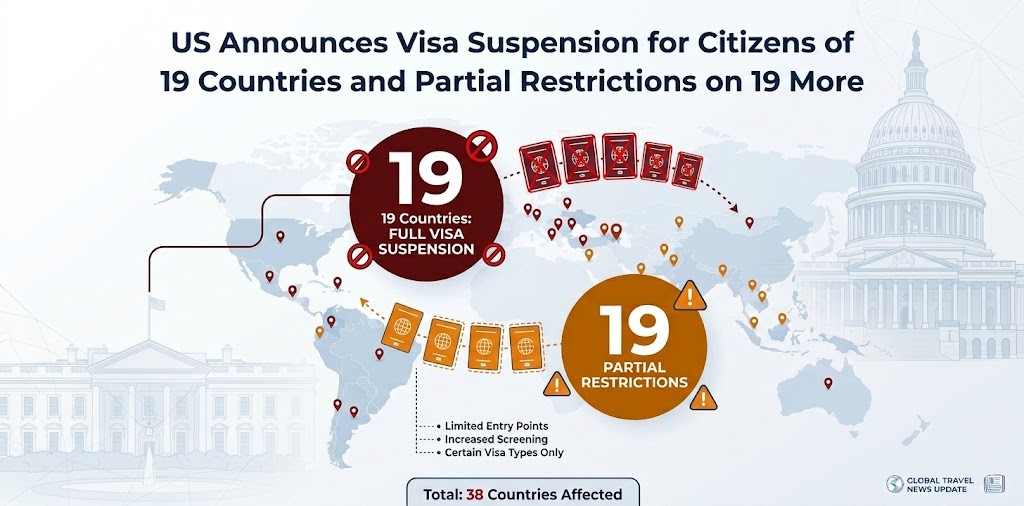
The United States government has enforced a sweeping shift in its global visa policy, cutting off entry permits for nationals of 19 states and rolling out partial bans on 19 others. A total of 39 nations are impacted by the executive measure, which also affects holders of Palestinian Authority travel documents. The sweeping directive, instituted through Presidential Proclamation 10998, took effect at 12:01 a.m. Eastern Standard Time on January 1, 2026.
Diplomatic authorities in Washington explained that the decision rests on the need to safeguard American borders and protect the homeland. According to the US Department of State, national security remains the primary justification behind the restrictions, which limit access across numerous travel classes. Consular offices handling applications overseas must now follow the directives set out in the presidential order, turning away applicants who fall outside a narrow list of allowed exemptions.
Scope of the suspensions and affected countries
The policy splits the targeted destinations into two distinct tiers. Under the first group, citizens from 19 nations face a total block on visa approvals. The Democratic Republic of the Congo features among the territories whose citizens can no longer obtain US entry permits under any regular classification, alongside people carrying Palestinian Authority travel papers. For people from this first category, all standard non-immigrant and immigrant processing has ground to an immediate halt.
A second tier slaps partial curbs on an additional 19 territories. In this group, consular officers have suspended processing for particular travel categories, including B-1 and B-2 visitor permits meant for holidays and business trips. Academic exchange pathways, covering F, M, and J student and exchange visitor permits, are likewise affected, alongside traditional immigrant visas meant for permanent relocation. The Republic of the Congo as well as Saint Kitts and Nevis feature on this partial restriction list.
For international travellers, obtaining an American visa typically involves rigorous vetting, extensive document reviews, biometric checks, and face-to-face interviews at local embassies. Consular officers historically retain broad discretion to decline requests if paperwork falls short or if an applicant fails to establish strong domestic ties. Proclamation 10998 overrides those standard individual reviews for the named categories, blocking issuance entirely based on nationality and passport status rather than personal qualifications.
What the curbs mean for Nigerian applicants
Nigeria has been listed under the partial restriction category, dealing a severe blow to thousands of families, scholars, and business owners. The country represents one of the busiest outbound travel markets on the African continent, with long appointment queues a constant reality at the American embassy in Abuja and the consulate general in Lagos. Getting an interview slot has long been a difficult task for ordinary citizens, often requiring months of waiting and planning.
Every year, thousands of Nigerians seek B-1 and B-2 visas to visit relatives, attend international industry conferences, source goods, or seek specialized medical care. Thousands more seek F-1 student visas to take up undergraduate and postgraduate admissions at American colleges and universities. Entire households invest substantial financial resources into school deposits, standardized tests, and visa processing fees in the hope of securing study permits for their children.
Placing bans on student paths, visitor visas, and permanent immigrant petitions will disrupt long-standing family ties and educational plans across Nigeria. Many professionals rely on quick access to international seminars to maintain business networks and foreign partnerships. Families waiting for years to conclude immigrant petitions will also find their relocation plans stalled while the policy remains active. The sudden halt leaves applicants who have already submitted paperwork and attended interviews facing profound uncertainty about their files.
Exemptions to the presidential order
Despite the broad reach of the rules, the American government established a narrow list of waivers within the proclamation text. The restrictions do not apply to individuals who already hold lawful permanent resident status, commonly known as green card holders. These permanent residents retain their right to enter and live in the country without running foul of the new restrictions.
Diplomatic visa holders are also excluded, allowing accredited envoys and state officials to continue travelling on official government business between capitals. Special Immigrant Visa recipients can still enter the country under the terms of the proclamation. Individuals holding dual citizenship may also qualify for processing, provided they apply and travel using a passport issued by an unaffected country.
The policy permits exceptions for athletes and team delegations taking part in select sporting competitions, ensuring major international tournaments are not disrupted by the travel freeze. Outside of these narrow windows, consular posts must turn down non-exempt requests originating from the listed nations under the terms of Presidential Proclamation 10998. Foreign missions in the affected capitals are now carrying out the order as written, leaving prospective travellers to wait for any potential diplomatic talks or future administrative reviews from Washington.


