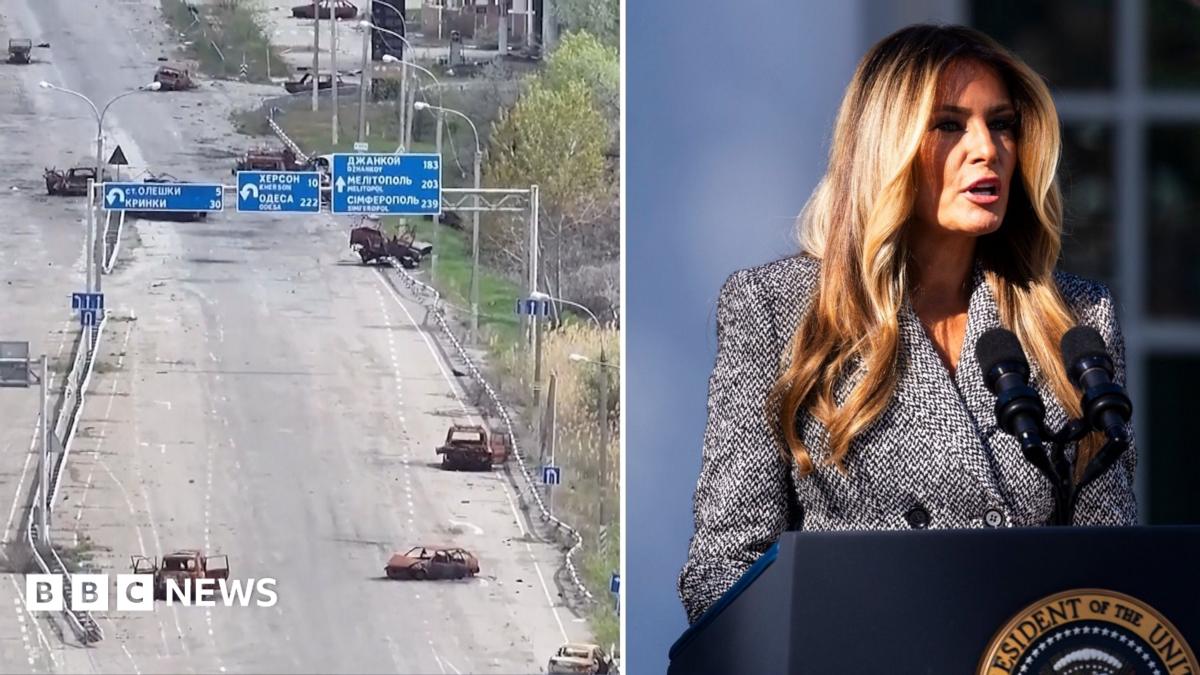
The White House confirmed on Friday that a truce in the Russian‑occupied Ukrainian city of Oleshky has taken effect, a pause in hostilities that the administration says was negotiated by US First Lady Melania Trump. The agreement, described as an “Oleshky truce” by officials, is intended to create a window for humanitarian aid deliveries and to enable the evacuation of civilians from the conflict‑scarred town. Residents who spoke to the BBC expressed a mixture of relief and apprehension, noting that the evacuation corridors could force them to travel through areas controlled by Russian forces or even into Crimea, raising concerns about safety and security.
The cease‑fire was announced late Thursday evening, with both Ukrainian and Russian‑backed authorities agreeing to suspend offensive operations for a limited period. According to a statement released by the White House, the truce will be in force on Friday, providing a narrow timeframe for trucks carrying food, medical supplies and other essentials to reach the beleaguered population. The statement also indicated that the evacuation plan would be coordinated with local officials and international humanitarian agencies, although the exact routes remain under discussion.
Melania Trump’s involvement was confirmed by senior White House officials who said the First Lady had been in contact with representatives from both sides for several days. While the specifics of her diplomatic outreach have not been disclosed, the administration highlighted her role as a “trusted intermediary” who helped bridge the communication gap that had stalled previous cease‑fire attempts. In a brief comment, a White House spokesperson said, “Mrs. Trump’s personal engagement contributed to a constructive dialogue that led to today’s agreement.”
Ukrainian officials have welcomed the development but remain cautious. A spokesperson for the Ukrainian Ministry of Defense noted that the truce is “a positive step, yet fragile,” and urged all parties to honor the terms without exploiting the lull for military repositioning. The ministry also stressed that the evacuation must be conducted in a manner that does not expose civilians to further danger, especially given the town’s proximity to the Russian border and the nearby annexed region of Crimea.
On the Russian side, a representative of the self‑declared “Oleshky administration” echoed similar sentiments, stating that the pause in fighting would allow “humanitarian assistance to reach those who need it most.” The spokesperson added that the authorities would cooperate with international observers to monitor the cease‑fire’s implementation, though they warned that any violation could lead to a swift resumption of hostilities.
BBC Ukraine correspondent Dan Johnson, who has been covering the frontlines for months, said the truce arrives at a critical juncture. “For the people of Oleshky, weeks of relentless shelling have devastated homes, schools and hospitals,” he reported. “The prospect of aid arriving and families being able to leave the city, even temporarily, is a relief, but the logistics are complicated by the fact that the only viable routes run close to or through Russian‑controlled zones.” Johnson also noted that previous attempts at temporary cease‑fires in the region had collapsed within hours, often because of mistrust and the difficulty of verifying compliance on the ground.
Local residents described a scene of tentative optimism tempered by wariness. One woman, who asked not to be named, told the BBC that she had stocked up on water and medicine in anticipation of the evacuation, but she remained uneasy about the possibility of being forced to cross into Crimea. “We are grateful for any chance to get out of this place,” she said, “but we do not know what will happen once we are on the other side.” Another resident, a father of three, expressed similar doubts, pointing out that the lack of clear information about safe corridors makes planning impossible. “If the route goes through enemy territory, we could be caught in a crossfire,” he warned.
Humanitarian organisations on the ground are preparing to mobilise quickly once the truce is in effect. The United Nations Office for the Coordination of Humanitarian Affairs (OCHA) has dispatched a coordination team to Oleshky, tasked with overseeing the distribution of aid and ensuring that evacuation procedures follow international standards. A spokesperson for OCHA said, “We stand ready to deliver life‑saving assistance, but we need unhindered access and security guarantees from all parties.” The International Committee of the Red Cross (ICRC) also indicated that its teams are on standby to assist with medical evacuations and to provide psychosocial support to traumatized civilians.
The broader context of the Oleshky truce reflects a pattern of intermittent cease‑fire negotiations that have punctuated the Ukraine‑Russia conflict since its escalation in 2022. While full‑scale peace talks have repeatedly stalled, localised truces have occasionally been brokered through third‑party mediation, often involving European or Middle Eastern actors. The involvement of a US First Lady marks a rare instance of an American political figure taking a direct diplomatic role in the conflict, a move that has drawn both praise and criticism from various quarters. Some analysts see the gesture as a soft‑power effort to keep US engagement visible, while others question the efficacy of informal channels in a war where strategic objectives dominate.
In Nigeria, the news has sparked conversation about the role of high‑profile individuals in international peace efforts. Observers note that, despite the geographical distance, the outcome of any truce in Eastern Europe can have ripple effects on global markets, including oil prices that directly affect the Nigerian economy. Moreover, the humanitarian dimension resonates with local NGOs that regularly deal with displacement crises in the North-East of the country, underscoring the universal challenges of protecting civilians in conflict zones.
As the truce unfolds, the immediate next steps involve the arrival of aid convoys and the coordination of evacuation buses. The White House has indicated that it will monitor the situation closely and is prepared to intervene diplomatically if violations occur. Meanwhile, Ukrainian and Russian‑aligned officials are expected to hold a joint verification meeting later on Friday to assess compliance and discuss the possibility of extending the cease‑fire beyond the initial window.
The success or failure of the Oleshky truce will likely be measured by whether aid reaches the town’s hospitals and whether families can leave safely without encountering hostile forces. For the residents who have endured months of bombardment, the coming hours are poised to determine whether a brief pause can translate into a tangible lifeline or merely a temporary lull before the next round of fighting. The world watches as the truce is put to the test, and the next report from the ground will reveal if the fragile peace holds.