


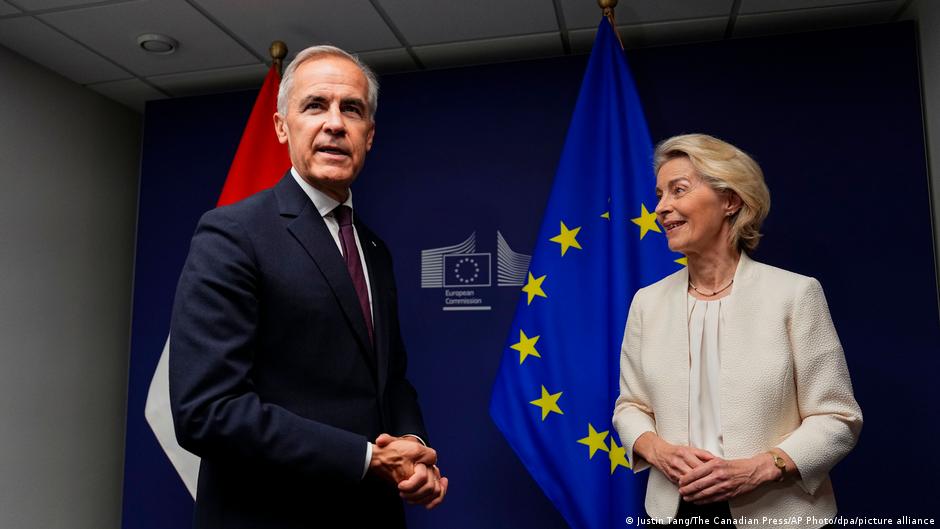
European Commission President Ursula von der Leyen’s ambition to give Canada a special “associate membership” status within the European Union hit an immediate roadblock on Wednesday. Germany, backed by a handful of other member states, succeeded in stripping the term from the draft declaration that would have opened the two‑day EU‑Canada summit in Montreal on Thursday. The revised text now speaks of “closer ties” between the bloc and Canada, sidestepping the contentious label that featured prominently in von der Leyen’s September address to the European Parliament.
German Chancellor Friedrich Merz led the effort to excise the phrase, arguing that the EU’s foundational treaties do not contain a provision for an associate‑member category. He warned that using a term without a legal basis could create confusion, especially after the same wording was floated in discussions about Ukraine’s possible pathway to full EU membership. France, Italy and several other capitals echoed the same concern, pointing out that the proposal had been presented with limited consultation of national governments. While all parties reiterated a desire for deeper cooperation, they insisted that any formal arrangement must respect the Union’s legal framework.
Prime Minister Mark Carney downplayed the terminology dispute, telling reporters that the substance of the partnership mattered far more than the label. He reaffirmed his support for the “Alliance for the Future” concept, a phrase he has used to describe EU‑Canada relations, and highlighted practical goals such as lowering trade barriers, encouraging investment and securing reliable supplies of critical raw materials, medicines and technology during emergencies. Carney stressed that Canadians are looking for tangible outcomes rather than symbolic status.
The revised declaration, approved by EU member states on Wednesday evening, still outlines an ambitious agenda for cooperation. It calls for expanded collaboration on energy, climate action, artificial intelligence, security and education, and envisions the creation of a new economic council that would bring together businesses from both sides of the Atlantic. The document also proposes a study into the feasibility of increasing Canadian liquefied natural gas (LNG) exports to Europe, and hints at broader access for Canada to EU research, education and defence programmes.
However, the shift from “associate membership” to a more modest “closer ties” framework trimmed several economic commitments that were originally slated for the summit. An explicit target of deeper financial‑market integration was removed, and promises of preferential treatment in economic‑security measures were replaced with language aimed at limiting negative spill‑over effects between the two economies. The softened language reflects the compromise needed to secure unanimous approval from the 27 member states.
The debate over Canada’s status touches on a broader question of how the EU can engage with non‑member partners while staying within the limits of its treaties. The Union’s legal architecture is built around a core set of accession rules that define full membership, and there is no established mechanism for granting a semi‑formal “associate” role. In recent years, the EU has experimented with various partnership models, from strategic partnerships with Japan and South Korea to deeper integration with the Western Balkans. Canada’s case was unique because von der Leyen’s proposal sought to give the country a seat at the table on major political and regulatory initiatives without the voting rights that come with full membership.
The timing of the renegotiated partnership is noteworthy. Both the EU and Canada have been reassessing their relationship with the United States under President Donald Trump, whose trade policies and territorial claims have raised doubts about Washington’s reliability as a partner. Trade disputes, new tariffs and the president’s rhetoric on “America First” have prompted European and Canadian officials to explore alternative avenues for economic security. By cementing a tighter EU‑Canada alliance, both sides hope to diversify their trade relationships and reduce dependence on a market that has become increasingly unpredictable.
Canadian officials see the “Alliance for the Future” as a way to safeguard supply chains for essential goods, especially in sectors such as pharmaceuticals and rare‑earth minerals where disruptions can have swift consequences. The proposed economic council, for example, would provide a platform for private‑sector stakeholders to discuss joint investment projects, potentially opening doors for Canadian firms in European markets and vice versa. Meanwhile, the study on LNG exports reflects Europe’s ongoing search for energy sources that can complement its push for greener alternatives while ensuring energy security amid geopolitical tensions.
From the European perspective, closer ties with Canada offer a chance to reinforce shared values on democracy, human rights and the rule of law. Both parties have aligned positions on climate targets and digital regulation, and cooperation on artificial intelligence could help shape standards that balance innovation with ethical safeguards. The revised declaration’s emphasis on security cooperation also signals an intention to coordinate more closely on defence and cyber‑threats, an area where transatlantic collaboration has traditionally been strong through NATO.
The removal of the associate‑membership label does not signal a retreat from ambition; rather, it illustrates the delicate balance EU leaders must strike between aspiration and legal reality. By framing the partnership in terms of “closer ties,” the EU can move forward with concrete projects while leaving room for future discussions about deeper integration, should member states eventually agree on the legal pathways needed.
As the summit proceeds, the final declaration, approved by the EU heads of government on Wednesday, will be published on Friday at the close of the talks. The document will set the tone for the next phase of EU‑Canada relations, outlining the specific mechanisms for the “Alliance for the Future” and detailing the steps for the proposed economic council, research collaboration and energy studies. All eyes will now be on how the revised language translates into actionable policies once the summit concludes.


