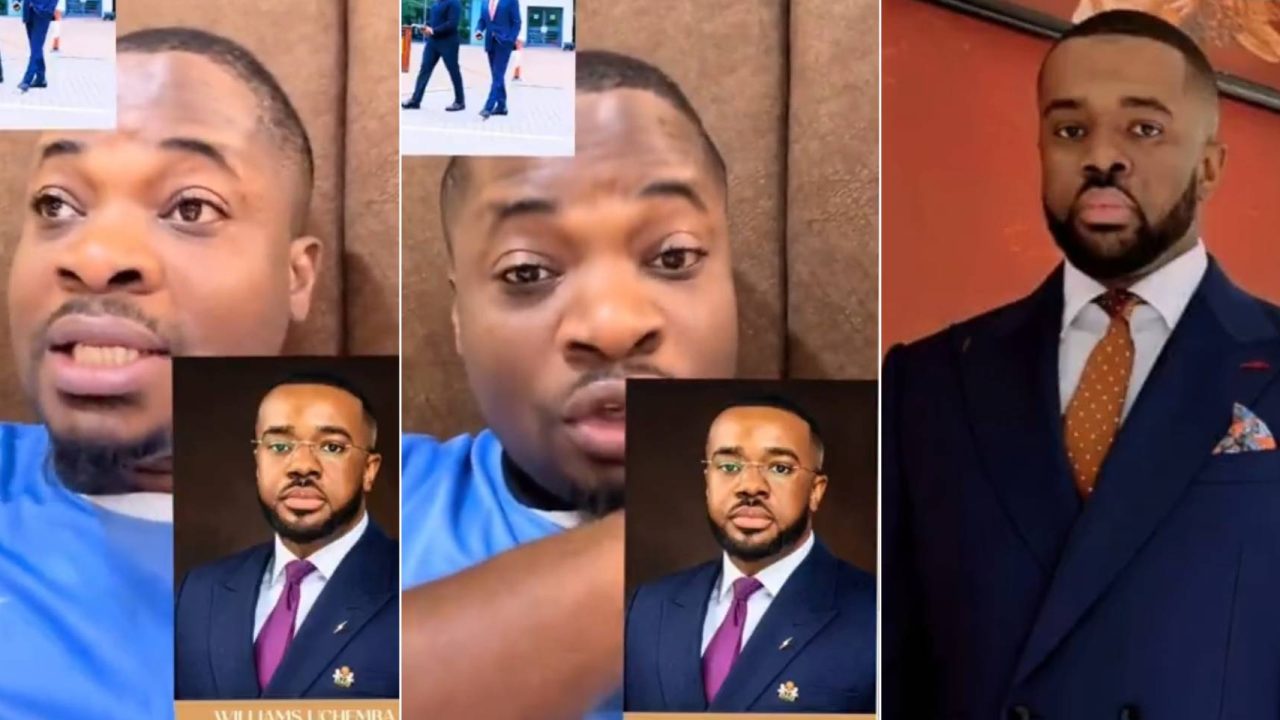
A social media user voiced astonishment on Tuesday, pointing out the sudden “william uchemba silence” on issues of bad governance after a reported death tied to an alleged NDC attack. The same post also highlighted that Enugu State Governor Peter Mbah, identified as the actor’s in‑law, has not publicly addressed the incident either. The user’s remarks quickly circulated, stirring a wider conversation about why both the entertainer and the governor have remained mute while the nation watches a politically charged incident unfold.
Social media backlash
The online message, posted on a widely used platform, quoted the user’s frustration: “Politics is really strong ooo. So, all of a sudden, actor William Uchemba is no longer talking about bad governance? If you knew him before, you wouldn’t believe he could change this way.” He went on to say the actor “has not even acknowledged that someone died during the NDC att@ck.” The criticism extended to Governor Mbah, described as “the actor’s in‑law,” who “has also not acknowledged the death.”
Comments poured in within minutes. Several users recalled Uchemba’s earlier interviews where he openly condemned corruption and called for better service delivery from elected officials. Those recollections were juxtaposed with the current silence, prompting accusations of inconsistency. Other commenters turned the focus to the governor, arguing that family ties should not shield a public official from the expectation of a prompt response. The thread grew into a mini‑forum where ordinary Nigerians debated the responsibilities of celebrities and politicians when community safety is at stake.
Background on the reported incident
Details of the alleged NDC attack remain vague. Media outlets have reported that an individual lost their life during a confrontation that involved members of the National Democratic Congress (NDC), a political organization that occasionally features in local clashes. In Nigeria, any violent episode linked to a political group tends to attract swift scrutiny from civil society organisations, human rights monitors, and the press.
The public’s demand for comments from high‑profile figures stems from a long‑standing cultural expectation that celebrities and elected leaders serve as moral compasses. When a well‑known actor who has previously used his platform to speak out on governance disappears from the discourse, it creates a noticeable void. Similarly, a state governor, especially one who is directly related to the actor, is expected to address any incident that could have political ramifications in his jurisdiction.
Responses from officials
At the time of writing, neither William Uchemba nor Governor Peter Mbah has released an official statement concerning the reported death. Attempts by journalists to reach the actor’s publicist and the governor’s press office were met with silence. This lack of response is being noted by observers as atypical, given both individuals’ history of engaging with the media on contentious topics.
Analysts suggest that the restraint may be strategic. In cases where investigations are ongoing, officials sometimes delay public comment to avoid influencing legal processes or to prevent the spread of unverified information. The NDC’s involvement adds a layer of sensitivity, as the group’s activities have, in the past, prompted security operations and heightened tensions.
What the silence may mean for the public
For many Nigerians, the expectation that prominent personalities weigh in on matters of public safety is rooted in the belief that visibility can drive accountability. When that visibility is absent, citizens often turn to social media to voice disappointment, as seen in the recent post. The episode illustrates how quickly public sentiment can coalesce around perceived inaction, especially when a well‑known actor and a state governor are involved.
The situation also brings the issue of family connections into sharper focus. Governor Mbah’s relationship to Uchemba has been repeatedly mentioned, suggesting that personal ties can amplify calls for transparency. In a political environment where nepotism is a frequent talking point, the public tends to scrutinise any hint that relatives may be shielding each other from criticism.
Wider implications for Nigerian public life
The incident show a broader pattern in Nigerian public life: the tension between the right to privacy and the perceived duty of public figures to comment on national concerns. While no law compels a celebrity or a governor to speak on every crisis, the court of public opinion often fills that gap. Social media platforms have become the de‑facto arena where citizens hold leaders accountable, bypassing traditional press briefings.
The episode may influence how future incidents are handled. If the silence persists, it could embolden other public personalities to adopt a similar low‑profile approach, potentially weakening the informal network of commentary that has historically supplemented official statements. Conversely, a delayed but substantive response from either Uchemba or Governor Mbah could reset expectations and reaffirm the role of personal influence in shaping public discourse.
Next steps
Monitoring agencies, local journalists and civil society groups continue to follow the story for any official statements that may emerge. Should either William Uchemba or Governor Peter Mbah decide to address the issue, their responses are expected to be widely reported across national media outlets. For now, the public discourse remains focused on the unanswered questions surrounding the alleged death and the apparent silence of two high‑profile individuals. The coming days will reveal whether the pressure from online commentators will prompt a break in the “william uchemba silence” and a formal acknowledgment from the governor’s office.